(Published in the US as The Dysfunctional Family’s Guide to Murder.)
Full Review
Fourteen year old crime fiction fan Ruth is almost at the end of a boring weekend-with-family at her rich step-grandmother (GG)’s farmhouse (no phone reception, no internet, no fun), when GG is discovered dead, her head bashed in by a typewriter. And her extended family and assorted hangers on are the only ones who could have done it. So, with the aid of her once-crush, now half-cousin Dylan (it’s complicated), Ruth puts her knowledge of murder mysteries into action to crack the case.
This was SO GOOD. I absolutely loved it. It’s so funny and so Australian. It’s very clearly inspired by fellow Aussie writer Benjamin Stevenson’s best-selling Everyone in My Family Has Killed Someone series, with constant breaking of the fourth wall by first person narrator Ruth and lots of fun metafictional references to crime genre features and other crime texts. The wisecracking similes and constant pop culture references clearly owe a lot to hardboiled detective novels, and are heaps of fun. The pace cracks along and there’s a tiny touch of romance. Read it!
Verdict: Fast-paced, wisecracking YA cosy crime GOLD
Title: My Family and Other Suspects
(Seems to me like a canny mash up of Benjamin Stevenson’s titles Everyone in My Family Has Killed Someone and Everyone on this Train Is a Suspect, with maybe a nod to Gerald Durrell’s My Family and Other Animals. Kudos. Love those books too.)
Tagline: None, but there’s a puff quote from the author of the Enola Holmes books, which tracks because there are heaps of Enola references in the book.
Author: Kate Emery
Cover: design by Alissa Dinallo
Published: Allen & Unwin Children, 2024
Length: 336 pages
ISBN: 9781526651846
Awards: not yet
Genre: detective fiction; suspense; humour
Representation: a minor character is Korean-Australian; another minor character (reported, never seen) is lesbian.
Suitability: years 7-12.
>>> Click here for content warnings (potential minor spoilers)
violent deaths/murder attempts (reported, not seen, not graphic); children given up for adoption (brief reports of past events, not traumatic); a long ago affair; divorce (briefly reported, not seen, not hostile); a couple of threatening scenes (which resolve in YA style); numerous minor injuries and a long-ish hospital stay (played for laughs); adults drinking wine & teenagers asking (fruitlessly) for some; a snake bite; serious deception; family arguments; a blink-and-you’ll-miss-it reference to “Bad Touching” (a momentary misunderstanding with no touching involved); frequent low level Aussie vernacular-style swearing (two f-words, lots of s-words, and a scattering of other very minor swears, e.g. hell)
Themes: crime fiction; family and belonging
Literary features/tropes: many, many, many. This is GOLD for anyone looking for a core text for a year 9 crime fiction genre unit. The novel is told through Ruth’s first person perspective, with lots of Benjamin Stevenson-style postmodern metafictional and self-referential elements. Ruth frequently breaks the fourth wall to foreshadow, as well as to create humour, intrigue and suspense, for example:
- “Am I taking too long to get to the murder? I might be taking too long to get to the murder. But without this helpful scene-setting, you’d have missed the clues about who did it. Did you notice them? There’ll be others.”
- “Perhaps, if I’d had a proper look around, I could have saved us all a lot of time and energy. Certainly, nobody else would have had to die.”
- “Laugh, if you want, but did you pick up the relevance of the clue on, say, pages 35 and 210? I wonder. (No, don’t look now: that’d be cheating.)”
She and other characters draw attention to crime fiction tropes, for example:
- “Aunty Bec doesn’t seem like a psychopathic killer but, in books, it’s always the last person you’d suspect.”
- “I consider grabbing the scissors out of GG’s sewing basket, but realistically, I’d probably trip down the stairs and impale myself on those tiny twin blades, and then everyone will think I’m The Second Victim.”
- ‘Didn’t you just call this a partnership and now you’re doing the thing all detectives do in books where they leave the sidekick in the dark until the last ten pages?’
Her narration is also full of intertextual references to other crime texts (as well as lots of other pop culture references, e.g. BTS, the Barbie movie, Jacob Elordi and The Real Housewives franchise), playfully emphasising the crime genre of the narrative. Small sample below:
- ‘I think we should leave the police to it,’ Aunty Bec says, ‘and forget all this Poirot-in-the-drawing-room bullshit.’
- ‘You’re not being nosy, you’re going full Jane Marple.”
- ‘Okay, Enola, where do we start?’
- “‘It’s a lead,” says Dad, sounding like an extra from a police procedural.”
- “Until now, he’s been the Watson to my Holmes: the sidekick with whom I can discuss my thoughts (mostly) and kick around theories (definitely).”
- ‘You’ve gone full Benoit Blanc, and I’m into it.’
And her constant use of wisecracking similes is reminiscent of the narration in classic hardboiled detective fiction novels, like those of Raymond Chandler, narrated by his famous private eye Philip Marlowe (e.g. “He looked about as inconspicuous as a tarantula on a slice of angel food” – Farewell, My Lovely 1940).
- “‘I should probably think about doing something for dinner,’ Aunty Bec says, with the intonation of someone who’s just announced an impending pap smear.”
- “”Right.’ Dad puts a whole lot of weird mustard on that single word, hitting that t with the enthusiasm of Mrs Labouchere, my choir teacher.”
- “Aunt Vinka’s teabags… smell like flowers, but taste like hot water that only met flowers at a party once.”
As cosy crime fiction, it features all the classic features of the genre, such as an amateur detective, sidekick, multiple victims, closed circle of suspects, motives, alibis, clues, red herrings, inheritance issues, progressive revelations of murder and non-murder related secrets, theories, investigations, a thrilling denouement and a thorough tying up of loose plot threads at the end.
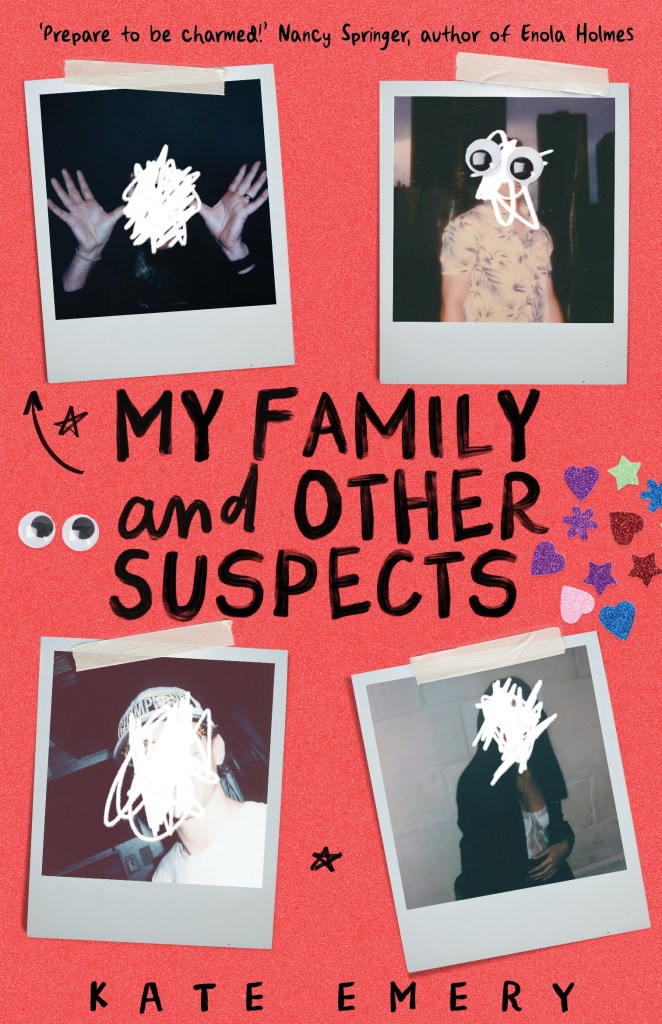
Cover notes: The cover emphasises the YA-ness of the novel and its lightheartedness, with the handwritten font, doodled stars, and the little scattering of hearts (subtle reference to the touch of romance?), stars and googly eyes. The dark, taped on polaroid-style photos with scribbled out faces convey a bit of A Good Girl’s Guide to Murder style tension
NSW syllabus: This would make an outstanding (and popular!) core text for a crime fiction genre unit, particularly in years 9 to 10. It’s also a good wide reading choice for years 7-12.
If you like this, try: Other funny Aussie YA detective fiction, e.g. Eleanor Jones Is Not a Murderer books by Amy Doak. Less funny but still pageturning YA detective fiction with teen girl protagonists, such as A Good Girl’s Guide to Murder series by Holly Jackson, the Truly Devious series by Maureen Johnson or the Enola Holmes books by Nancy Springer. Other lighthearted Aussie crime that breaks the fourth wall, like Everyone in My Family Has Killed Someone or Everyone on this Train is a Suspect by Benjamin Stevenson. Classic detective fiction, such as The Big Sleep by Ramond Chandler, Murder on the Orient Express or Death on the Nile by Agatha Christie, or The Hound of the Baskervilles by Arthur Conan Doyle. Or what about another book by Kate Emery – I haven’t read The Not So Chosen One yet, but I definitely will now!
*
Images are used on this blog post under the “Fair dealing for criticism or review” provision of the Commonwealth Copyright Act, 1968.
 MEANWHILE, BACK AT THE LIBRARY...
One Comment Add yours