Review
A small spacecraft, inhabited by six astronauts from different countries (Russia, US, UK, Japan & Italy), orbits the earth. The astronauts wake up each day and go about their tasks — exercise, scientific experiments on plants or mice, routine maintenance, weather and other observations, eating, talking, sleeping, dreaming. While they do, they think about memories of people left behind, and become awed and absorbed by the wonder, beauty and power of the planet as they watch it from above.
*
It’s really hard to describe most literary works in terms of plot: often not a lot happens. Most of the interest is on a thematic level and in the beauty of the language. That’s why most the critics’ adjectives on the cover are pretty much about that beauty: “beautiful”, “awe-inspiring”, “stunning”, “exquisite”, “beautiful” (again), “gorgeous”, “luminous”, and “beautiful” (yet again).
It’s all true. This novella is beautiful.
(The Guardian calls it “uplifting”. Also true.)
It’s written from a gentle, almost dreamy third person omniscient perspective, with brief excursions into direct address (“You…”). We enter into each astronaut’s perspective, their thoughts and feelings. There are gorgeous descriptions of the earth as seen from space. And gradually, through an accumulation of small moments and images, some ideas emerge. One of them is the beauty of Earth and space and, attached to that, its fragility, its vulnerability to human exploitation. Another is global harmony: more unites us than divides us. That our individual, human lives are brief, tiny, mere specks in the sweep of time and space. Paradoxically, we also learn about the human condition: our determination, curiosity, a wondering, adventuring spirit. A capacity for awe, love, grief, philosophical reflection and tenderness.
That may all sounds a bit heavy handed, but it isn’t: it’s explored with a light touch (with slightly more obvious, wrap up-style imagery, emphasising main ideas in the final chapter).
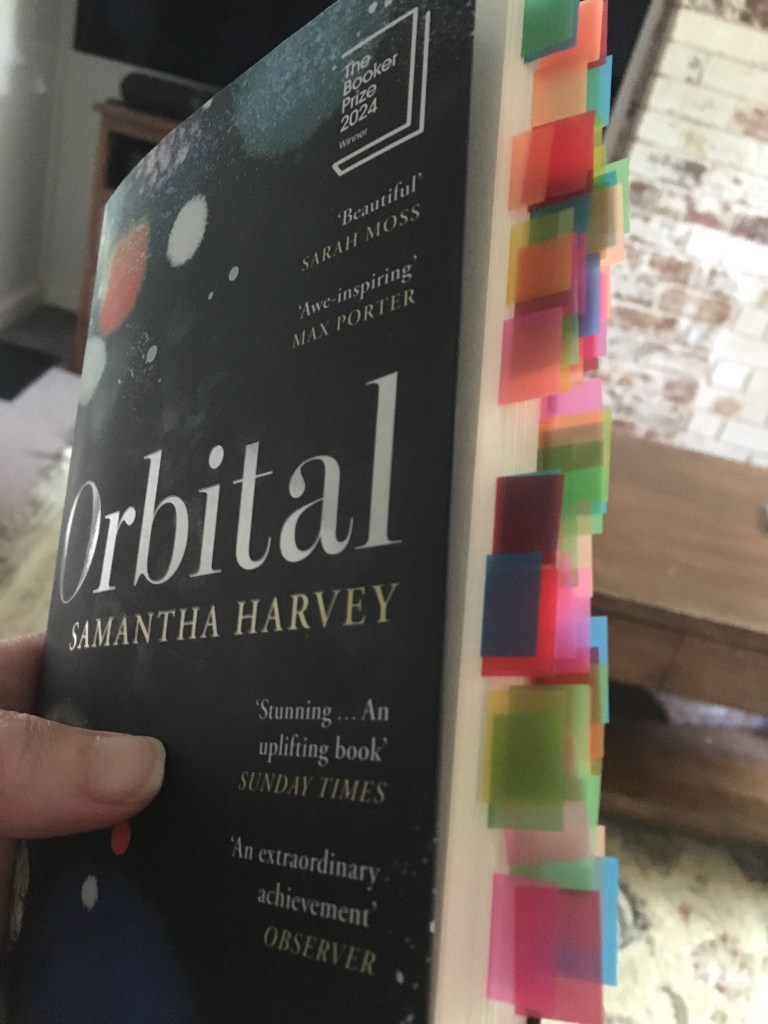
Here are just a few samples:
In the new morning of today’s fourth earth orbit the Saharan dust sweeps to the sea in hundred-mile ribbons. Hazy pale green shimmering sea, hazy tangerine land. This is Africa chiming with light.
(p. 25)
Not encouraging thoughts, as Roman says. Anton asks him a while later if he worries about this.
No, he says. Never. And you?
Beneath them the South Pacific now passes in absolute night, an endless pit of black, and there is no planet, just the gentle green line of the atmosphere and numberless stars, astonishing solitude, everything so near and infinite.
No, Anton answers. Never.
(p. 27)
Maybe one day we’ll look in the mirror and be happy with the fair-to-middling upright ape that eyes us back, and we’ll gather our breath and think: OK, we’re alone, so be it. Maybe that day’s coming soon. Maybe the whole nature of things is one of precariousness, of wobbling on a pinhead of being, of decentring ourselves inch by inch as we do in life, as we come to understand that the staggering extent of our own non-extent is a tumultuous and wave-tossed offering of peace.
(p. 30)
It’s just so deftly done. Nothing disturbs the dreamy tone that echoes (perhaps?) the distance that the spacecraft has from the earth and the astronauts’ weightless floating. It’s astonishingly lovely. I highly recommend reading this book. It’s only 136 pages, although as literature, it takes a bit longer to read because you’re dwelling on its ideas and its beauty. (Well, you will with this one, anyway.)
On a more practical level, this would be a killer related text for Texts and Human Experience. (That’s a NSW HSC thing — senior English students have to independently analyse their own choice of text for its depiction of the human condition.) It’s short; it’s rich; it’s all over the human condition like white on rice; and it also won the Booker (2024), so it has unquestionable literary cred.
Age: any age, but probably more appealing for 16+
> Click here for content information. Minor spoilers — enter at own risk.
An astronaut’s mother dies while she’s in space, and she grieves; a massive typhoon threatens (and takes) lives and houses in the Phillipines — people are injured, worried and made homeless. No sexual references, no swear words.
*
Harvey, S. (2024). Orbital. Vintage.
Images are used on this blog post under the “Fair dealing for criticism or review” provision of the Commonwealth Copyright Act, 1968.
 MEANWHILE, BACK AT THE LIBRARY...