Review
Gwen is a blacksmith’s daughter (actually, she’s doing all the blacksmithing herself these days) who dreams of being a knight, practising in the orchard with her horse Achilles.
Lady Isobelle is a society beauty, a force of nature and the charismatic queen bee of a group of well dressed coterie of friends. She meets Gwen at a local market, where Gwen is trying to sell horseshoes and Isobelle suddenly decides that she’s going to make horseshoes all the rage.
Unfortunately for Isobelle, her not-very-nice guardian is about to make her and her dowry the prize for the Tournament of Dragonslayers — a fancy name for a jousting competition, as dragons have long since disappeared. The tournament favourite is Sir Ralph, a particularly lecherous and icky middle aged knight. Isobelle is not happy.
But when the unknown and mysterious Sir Gawain enters the knockout rounds and actually wins against a well known local knight, Isobelle recognises the sword that the Gawain raises in triumph — last seen in the hands of a blacksmith called Gwen — and starts to form a plan that will get her out of a forced marriage to any man.
*
I bought this book for the school collection (almost) purely on the strength of its cover. Look at this beauty:
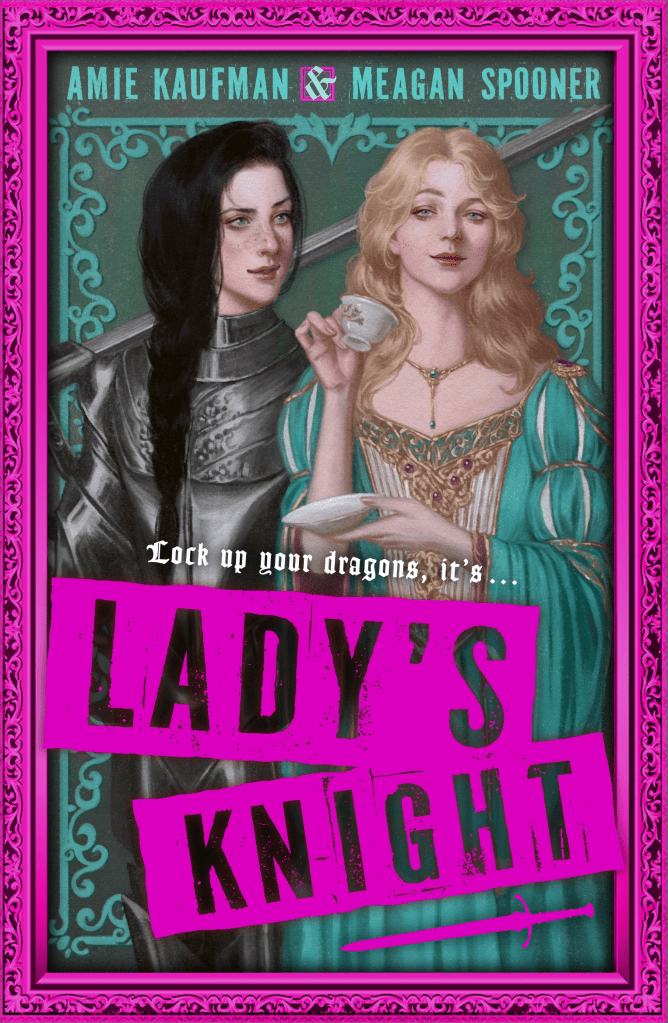
It also had really good inside cover reviews from authors I like. And the overall vibe was that quirky, deliberately anachronistic historical fantasy subgenre populated by books by the Lady Janies (My Lady Jane & My Salty Mary) and Lex Croucher (Gwen & Art Are Not in Love and Faint of Heart). Or a sapphic fantasy version of A Knight’s Tale (2001). Sounds fun, sign me up!
Overall, I’d say this is a good read for fantasy fans: it’s got humour; it’s got drama; it’s got romance. However, it does tend to change gear a little clunkily between these modes. One moment it’s all self-aware humour, and then there’s a long stretch of drama. The tone’s uneven. I will also say that the romance, although quite sweet, does not provide much in the way of romantic thrills, and the actual ending of the book is a bit meh (although the main action wraps up fine).
Periodically there’s an explicitly intrusive metafictional narrator who muses lightheartedly for a couple of italicised pages about settings, characters & events, for example —
By now, dear reader, you’ve probably decided that Lord Whimsitt is our villain.
— or progresses the plot with a narrated montage (explicitly called a montage). I quite enjoy that sort of thing, but it doesn’t float everybody’s boat.
The ethos is distinctly feminist, of the smash-the-patriarchy variety (also to my taste), and the deliberate anachronisms include Isobelle and her gang going out for ‘coquetels’ on ‘Lady’s Night’, rappelling off balconies, eating ‘cheesecake on a stick’ at the markets, and indulging in far more romantic fun than real medieval ladies would ever get a sniff of.
There are plenty of holes you could pick in the plot (e.g. Isobelle is into horseshoes? Gwen can beat an experienced knight at jousting?). But given the general vibe of the thing, why bother? Just enjoy.
Suitable for year 7 & up; 480 pp.
> Click here for content info — spoilers, enter at own risk!
Violence & injuries of the knights, jousting and dragons variety; some social drinking (‘coquetels’, ale, wine, spirits); patriarchal b.s. and toxic masculinity (resisted); class divisions — authors are very respectful and inclusive of ‘lower’ classes, and the Gwen/Isobelle romance crosses class divides; Gwen always knew that she fancied women, but it’s a new realisation for Isobelle; a few kisses, all very PG; at one point some castle guards are drugged with custard tarts in the pursuit of justice; occasional swears, including a couple of f-words. Main romance is wlw. Minor relationships are mostly mlw.
*
Kaufman, A., & Spooner, M. (2025). Lady’s knight. Allen & Unwin.
Images are used on this blog post under the “Fair dealing for criticism or review” provision of the Commonwealth Copyright Act, 1968.
 MEANWHILE, BACK AT THE LIBRARY...